Bharat News Warangal… Beer Chief .BTR: A Guiding Light for the Labor Movement.
He was the very epitome of discipline.
To carry forward his ideals is to dedicate oneself completely to that path.
— Speakers at the BTR Memorial Meeting
Bureau Chief, Warangal | April 6
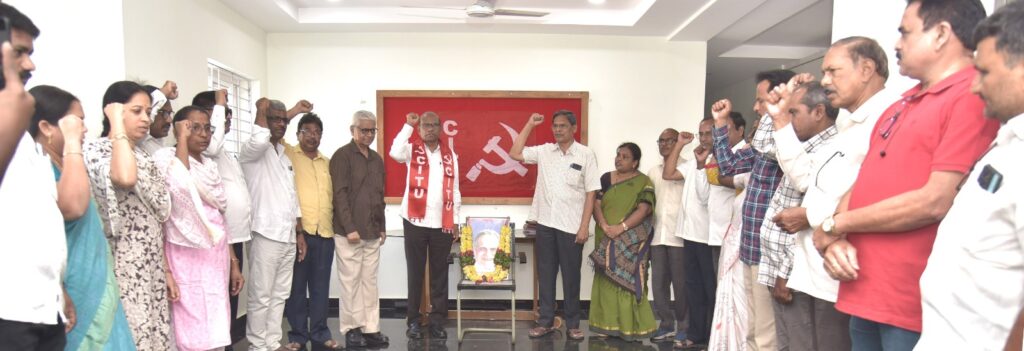
B.T. Ranadive served as a guiding light for the labor movement; the discipline he demonstrated within the revolutionary movement is of immense necessity for the present generation. “In the current circumstances, strengthening the labor movement constitutes the true tribute we can pay to him,” speakers stated. On Monday, the 36th death anniversary of BTR was observed at the CITU state office in Hyderabad, presided over by the organization’s State General Secretary, Paladugu Bhaskar. On this occasion, CITU State President Chukka Ramulu, Vice Presidents R. Sudhabhaskar and S. Veerayya, along with other office bearers, garlanded his portrait and paid their tributes.
Speaking subsequently, Chukka Ramulu remarked that Ranadive’s fighting spirit, his ideological commitment, and—specifically—the direction he provided to the Indian labor movement serve as a guiding light for the current movement. He asserted that it is impossible to discuss the Indian labor movement without mentioning Ranadive’s name. He lauded him not merely as a leader of the national movement, but as a leader who had cultivated a correct and profound understanding of Marxism. He noted that Ranadive played a pivotal role in building the labor movement from the grassroots level. He further recalled the significant role Ranadive played in the establishment of CITU and in organizing it into a cohesive entity. He explained that Ranadive’s contribution in positioning CITU as a compass and guiding force for the working class is indelible. He pointed out that, as is well known to all, the guidelines he formulated—centered on the CITU’s motto—proved highly practical in ensuring that the unity of trade unions remained at its highest possible level. He also provided a clear perspective regarding the attitude that should be adopted toward working women. He emphasized that organizing the unemployed is crucial for the trade union movement, and that for the right to collective bargaining to be upheld, the issue of unemployment… He stated that BTR had emphasized the importance of never abandoning the rank-and-file—a responsibility that lies squarely with the trade union. He called upon everyone to deeply study BTR’s teachings and writings in order to propel the labor movement forward. He noted that it is crucial to help the working class understand the distinct interplay between caste and class within our country, adding that BTR’s seminal paper, Caste and Class, remains a definitive reference point to this day. He also highlighted that BTR was a contemporary of Dr. B.R. Ambedkar. He urged everyone to take the CITU’s perspective to the grassroots level: specifically, the understanding that the fight against social discrimination must be integrated with class struggles—advancing it as an integral part of the class movement rather than allowing it to be subsumed by identity politics alone. In this context, he called for the success of the “Social Justice Campaign” scheduled from the 6th to the 14th of this month, urging everyone to carry forward BTR’s intellectual legacy.
Speaking on the occasion, R. Sudhabhaskar remarked that if one were to describe BTR, the foremost attribute to highlight would undoubtedly be his discipline. He recalled that in 1942, while serving as the Party’s General Secretary, BTR faced disciplinary action from the Party; yet, he remained a loyal ordinary member and eventually returned to the Politburo. Sudhabhaskar contrasted this with the present-day reality, where we often observe individuals facing similar situations simply abandoning their party to defect to a rival political organization. He noted that, possessing such exemplary discipline, BTR developed the Party through constructive and systematic methods. He urged all contemporary activists to study BTR’s writings and put his principles into practice. He concluded by stating that, in the days to come, truly dedicating oneself to BTR’s ideals implies that everyone must remain steadfastly committed to upholding his standard of discipline. He made this appeal. Speaking on the occasion, S. Veerayya described BTR as a leader who demonstrated, through his actions, the true meaning of unity and struggle. He noted that BTR was not merely a contemporary of Ambedkar; he also recalled that BTR had organized numerous labor strikes and struggles in collaboration with Ambedkar. He highlighted that BTR had articulated how a narrow understanding of caste—specifically, the notion that caste would simply vanish on its own—was flawed. He stated that BTR was the individual who fostered a clear and comprehensive understanding regarding caste, caste discrimination, and class struggle. He further mentioned that BTR had advocated for working-class unity and collective struggle as the means to combat caste discrimination. He lauded BTR as a great leader who fearlessly articulated the correct perspective and formulated a comprehensive policy document on these issues. He urged everyone to deeply study and follow the path laid out by BTR, ensuring they do not fall prey to misconceptions or erroneous influences regarding the issue of caste. He stated that the “Social Awareness Week” being observed today is being organized in that very spirit. He reiterated that BTR possessed a clear and scientific understanding of the caste issue, and it is for this reason that these week-long observances are being conducted to mark his death anniversary.
Office bearers—including Bhupal, J. Venkatesh, SV, Rama, J. Mallikarjun, M. Padmasri, VS Rao, K. Eshwar Rao, Vangooru Ramulu, B. Madhu, Kurapati Ramesh, B. Mallesh, A.J. Ramesh, Kasu Madhavi, A. Muthyam Rao, P. Srikanth, P. Sudhakar, R. Triveni, and B. Kavita—along with State Committee members Yatala Somanna, A. Sunitha, and others, participated in this program.